
Updated August 2026 | CISSP Exam Preparation Guide
Passing the CISSP exam on your first attempt is not primarily a memorization challenge.
The candidates who prepare most effectively understand what CISSP is really testing: broad cybersecurity knowledge, sound professional judgment, risk-based decision-making, and the ability to choose the best answer when several options appear technically possible.
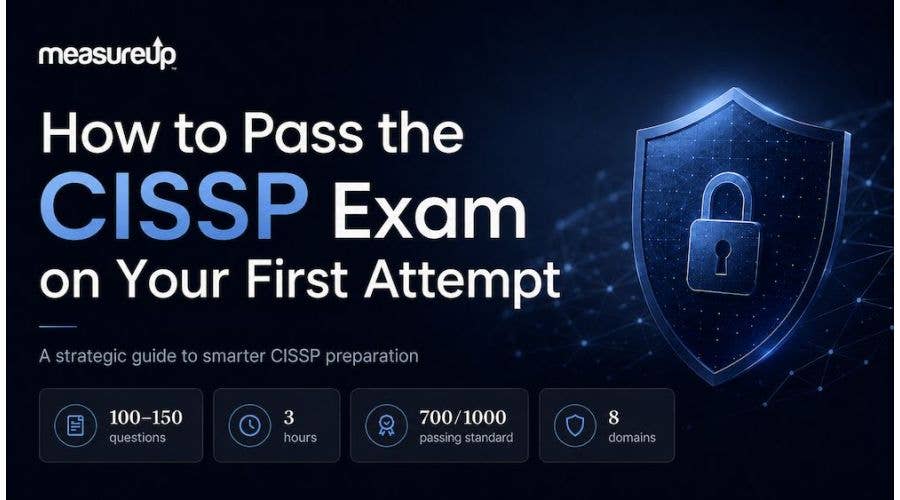
The current CISSP exam uses Computerized Adaptive Testing (CAT), contains between 100 and 150 questions, and gives you a maximum of three hours. The official passing standard is 700 out of 1,000 points.
This guide shows you how to build a realistic CISSP study strategy, identify weak areas, use practice tests correctly, improve your decision-making, and determine when you are genuinely ready for exam day.
CISSP exam at a glance
The most important idea in this guide: do not measure CISSP readiness by how much material you have consumed. Measure it by how consistently you can retrieve, apply, and explain what you know.
STEP 1
Understand the CISSP Exam Before You Start Studying
One of the easiest ways to waste time preparing for CISSP is to begin studying without first understanding the exam you are preparing for.
According to the current official ISC2 CISSP Exam Outline , the exam has the following structure:
| Exam feature | Current format |
|---|---|
| Format | Computerized Adaptive Testing (CAT) |
| Questions | 100–150 |
| Maximum time | 3 hours |
| Passing standard | 700 out of 1,000 |
| Domains | 8 |
| Review previous answers? | No |
Important: 700/1000 does not mean 70% correct
ISC2 uses a scaled passing standard and an adaptive algorithm. Your result should not be interpreted as a simple raw percentage of correct answers.
Trying to calculate your score while taking the test is therefore a distraction. Your objective is to make the best possible decision on the question currently in front of you.
STEP 2
Know the Eight CISSP Domains and Their Exam Weights
CISSP is deliberately broad. Even highly experienced cybersecurity professionals frequently discover that their everyday role covers only part of the certification blueprint.
| CISSP domain | Weight |
|---|---|
| Security and Risk Management | 16% |
| Asset Security | 10% |
| Security Architecture and Engineering | 13% |
| Communication and Network Security | 13% |
| Identity and Access Management (IAM) | 13% |
| Security Assessment and Testing | 12% |
| Security Operations | 13% |
| Software Development Security | 10% |
Study priority = exam weight + personal weakness.
A 10% domain you consistently fail may deserve more study time than a 16% domain
you already use every day.
AI security is now part of the CISSP landscape
The current ISC2 outline explains how artificial intelligence and machine learning security considerations intersect with all eight CISSP domains.
Topics can include AI governance and risk, protection of models and training data, prompt injection, adversarial attacks, non-human identities, AI security testing, AI-assisted security operations, and software supply-chain risks.
Do not treat AI security as a separate ninth domain. Learn how emerging technologies affect the security principles that CISSP already expects you to understand.
STEP 3
Take a Diagnostic Test Before Building Your Study Plan
Many candidates make the same inefficient decision: they start on page one of a CISSP study guide, work through every chapter in order, and wait until the end to discover what they actually know.
A better strategy is to establish a baseline first.
Take a practice assessment early. Your objective is not to pass it. Your objective is to discover where your preparation should begin.
You did not understand or remember the underlying concept.
You knew the concept but could not apply it correctly to the scenario.
You missed qualifiers such as BEST, FIRST, MOST, or PRIMARY.
You chose a technical response when the question required a governance, risk, or management decision.
You introduced information or assumptions that were not present in the scenario.
Two candidates can miss exactly the same question for completely different reasons. That means they also need different remediation.
Build your CISSP study plan from evidence about your performance, not assumptions about what you probably know.
STEP 4
Study CISSP Concepts, Relationships, and Decisions
Recognition is not the same as mastery.
Reading terms such as Bell-LaPadula, SAML, Kerberos, RTO, due diligence, data remanence, or separation of duties and thinking “I remember this” can create false confidence.
Test every important concept with four questions:
- What does it mean?
- What problem or risk does it address?
- When would I use it?
- Why would I choose it instead of a plausible alternative?
If you cannot answer those questions without looking at your notes, the topic probably is not exam-ready yet.
Use active recall instead of endless rereading
After studying a topic, close the book or course and reconstruct the idea from memory. Explain it aloud, write a short summary, draw the process, or answer questions without referring to the source material.
Then revisit the concept later rather than repeatedly rereading it during the same study session.
Connect domains instead of treating them as eight separate subjects
Real cybersecurity decisions rarely belong to a single CISSP domain.
An identity-related incident can involve IAM, network security, logging, incident response, asset classification, privacy requirements, business continuity, and application security.
As your preparation progresses, deliberately connect concepts across domains. That will make unfamiliar scenario questions considerably easier to interpret.
STEP 5
Develop the CISSP Mindset: Think Like a Security Leader
You will often hear that candidates need to “think like a manager” to pass CISSP.
That advice is useful only when interpreted correctly.
The CISSP mindset does not mean “always choose the least technical answer.” It means understanding security in the context of organizational objectives, risk, governance, accountability, policy, legal obligations, and business impact.
When several answers seem reasonable, ask:
- What exactly is the question asking me to decide?
- Who owns this decision or risk?
- Is it asking for the first action or the final solution?
- Should an assessment, approval, or policy decision happen before implementation?
- Which option addresses risk while supporting business objectives?
- Am I fixing an immediate symptom while ignoring the wider problem?
Example: technical fix versus risk-based decision
Imagine a serious vulnerability has been discovered in a business-critical production system.
Your technical instinct may be to patch immediately.
But if the question asks what should happen first, the better CISSP answer may involve assessing business impact, following change-management procedures, escalating to the appropriate risk owner, or determining whether compensating controls are necessary.
The patch can still be necessary. The question may simply be testing whether you understand the correct sequence of decisions.
STEP 6
Turn CISSP Practice Questions Into a Learning System
Practice questions are one of the most powerful CISSP preparation tools available — if you use them correctly.
Ineffective approach
Answer 100 questions → Check the score → Repeat
Better approach
Answer → Analyze → Classify the error → Repair the gap → Retest the concept
Review more than incorrect answers
After every practice session, review:
- Questions you answered incorrectly.
- Questions you guessed correctly.
- Questions where you were unsure between two options.
- Questions you answered correctly using flawed reasoning.
A lucky correct answer should not be counted as mastery.
Keep a CISSP error log
Create a simple spreadsheet or document containing the topic, the concept you missed, the correct reasoning, and the underlying reason for the mistake.
Do not simply collect scores. Look for patterns.
You may discover that “cryptography” is not really your weakness — key management is. Or that you know incident response but repeatedly select the wrong phase of the process.
Do not memorize practice-test answers
Repeated exposure creates recognition. Recognition can improve your score without improving your competence.
After reviewing a question, explain why the correct option is best and why each plausible distractor is weaker. If the scenario changed tomorrow, you should still understand the underlying principle.
Practice smarter
Find your CISSP weak areas before exam day
Use the MeasureUp CISSP Practice Test to identify knowledge gaps, study explanations in Practice Mode, and progressively move toward exam-style sessions in Certification Mode.
STEP 7
A Practical 12-Week CISSP Study Plan
There is no universal number of study hours that guarantees a CISSP pass. Your professional experience and current knowledge across the eight domains matter enormously.
However, this framework provides a useful starting point for experienced cybersecurity professionals.
| Period | Goal | What to do |
|---|---|---|
| Week 1 | Baseline | Review the Exam Outline, take a diagnostic test, and rank domains from strongest to weakest. |
| Weeks 2–4 | Core knowledge | Focus on weak, high-impact domains while continuing to review stronger areas. |
| Weeks 5–7 | Complete coverage | Cover all eight domains using active recall and scenario-based questions. |
| Weeks 8–9 | Integration | Mix domains and focus on relationships between concepts. |
| Week 10 | Weakness elimination | Analyze your error log and attack recurring mistakes. |
| Week 11 | Simulation | Complete timed mixed-domain sessions without hints or immediate explanations. |
| Week 12 | Consolidation | Review persistent gaps, high-value notes, and exam strategy. |
Do not let the calendar override the evidence. If a significant knowledge gap appears during week 10, fix it instead of moving on simply because your schedule says you should.
STEP 8
Prepare Specifically for the CISSP CAT Exam
Computerized Adaptive Testing changes both the technical and psychological experience of the exam.
After each response, the system updates its estimate of your ability and selects another question designed to measure that ability efficiently.
What CAT means for you on exam day
- Expect questions to continue feeling challenging.
- You cannot return to previous questions.
- More than 100 questions does not mean you have failed.
- Reaching 150 questions does not reveal your result.
- Treat every question as if it is scored.
You cannot go back
Once you submit an answer, you cannot return to review or change it.
Your final practice sessions should therefore replicate that behavior: make a careful decision, submit it, and mentally move on.
Do not try to decode the algorithm
Trying to infer whether you are passing from the apparent difficulty or number of questions wastes cognitive energy.
Focus on the only question you can influence: the one currently on the screen.
STEP 9
How to Know When You Are Actually Ready for CISSP
“I finished my study guide” is not an exam-readiness metric.
Neither is “I watched every video in the course.”
Look instead for consistent evidence that you can perform the skills CISSP requires.
You are approaching exam readiness when:
- You have reviewed every objective in the current Exam Outline.
- You can explain important concepts without notes.
- You can apply concepts to unfamiliar scenarios.
- Your mixed-domain performance is consistent.
- Your weakest areas are improving.
- You understand why plausible distractors are wrong.
- You can distinguish technical questions from governance and risk questions.
- You can maintain concentration during timed practice.
- You are comfortable committing to an answer without returning to it later.
The key word is consistency.
One excellent score is encouraging. Repeated strong performance across different domains and question sets provides much stronger evidence of readiness.
Common CISSP Study Mistakes That Can Cost You the Exam
1. Memorizing instead of understanding
Memorization is necessary for some terminology and foundational facts, but knowledge becomes fragile when the question changes the context.
2. Studying only your favorite domains
Cybersecurity professionals naturally gravitate toward the areas they use at work. CISSP rewards breadth, so invest more time in demonstrated weaknesses.
3. Using practice tests only to generate scores
The explanation behind a mistake is often more valuable than the final percentage. Use every meaningful error to improve your reasoning.
4. Applying absolute “CISSP rules”
Rules such as “always choose the manager answer” are too simplistic. The right answer depends on the scenario, decision level, responsibilities, and stage of the process.
5. Trusting unofficial CISSP pass-rate statistics
ISC2 does not disclose official certification exam pass-rate information to training providers. Treat unsupported percentages online with caution.
6. Trying to learn everything in the final 48 hours
Your last days should emphasize targeted review, confidence, logistics, sleep, and consolidation — not panic-driven content consumption.
CISSP Exam-Day Strategy
Your exam-day strategy should be simple enough to follow even under pressure.
Read the question before solving the scenario
Identify whether you are being asked for the FIRST, BEST, MOST appropriate, PRIMARY, or long-term response.
A single qualifier can completely change which answer is correct.
Eliminate before selecting
Remove options that:
- Do not answer what was actually asked.
- Occur at the wrong stage of the process.
- Operate at the wrong organizational level.
- Require assumptions not provided in the scenario.
- Ignore stated legal, business, policy, or risk requirements.
Do not fight the question
The exam is not asking what your employer normally does or which technology you personally prefer. Answer the scenario as written.
Once you answer, move on mentally
Because the CAT exam does not allow you to return to previous questions, thinking about the last answer provides no benefit.
Give the next question your full attention.
What Happens After You Pass the CISSP Exam?
Passing the examination and becoming fully CISSP-certified are related but separate milestones.
Candidates generally need five years of cumulative professional experience in two or more of the eight CISSP domains.
A qualifying degree or approved credential may satisfy up to one year of that requirement.
Candidates who pass the exam before meeting the experience requirement can become an Associate of ISC2 while completing the necessary experience.
Because ISC2 can update its approved credential-waiver list, always verify the current requirements directly with ISC2 before relying on an older certification list.
Frequently Asked Questions About Passing the CISSP Exam
How hard is the CISSP exam?
CISSP is challenging because it combines broad technical knowledge with security management, governance, risk, architecture, operations, and scenario-based decision-making. Its adaptive format is also designed to remain challenging throughout the exam.
What score do you need to pass CISSP?
The official passing standard is 700 out of 1,000. It is a scaled score and should not be interpreted as simply requiring 70% correct answers.
How many questions are on the CISSP exam?
The current CISSP CAT exam contains between 100 and 150 questions, with a maximum administration time of three hours.
Can you return to previous CISSP questions?
No. Once you finalize an answer in the CAT exam, you cannot return to review or change it.
Does getting 150 questions mean you failed?
No. The number of questions alone does not reveal your result. The adaptive system may continue because it requires more information to determine whether your demonstrated ability meets the passing standard.
What is the CISSP pass rate?
ISC2 does not disclose certification exam pass-rate information to training providers. Be cautious with websites presenting unofficial percentages as if they were ISC2 statistics.
How long should I study for CISSP?
There is no universal preparation period. Your study timeline should depend on your experience and diagnostic performance across all eight domains. A 12-week framework may work well for experienced professionals, while other candidates may need longer.
Can I take CISSP without five years of experience?
Yes. You can pass the exam before meeting the full experience requirement. Candidates who do not yet qualify for full certification can become an Associate of ISC2.
Final readiness check
Are You Ready for Your First CISSP Attempt?
- I have studied the current CISSP Exam Outline.
- I know my strongest and weakest domains.
- I can explain important concepts without notes.
- I regularly practice mixed-domain scenarios.
- I analyze the reasoning behind mistakes.
- I understand technical versus governance-level decisions.
- I have practiced under timed conditions.
- I can commit to an answer without returning to it.
- My practice performance is consistent.
- I will not try to interpret my result from CAT question difficulty or exam length.
How to Pass the CISSP Exam on Your First Attempt: The Bottom Line
There is no shortcut that can guarantee a first-attempt CISSP pass.
There is, however, a much more effective way to prepare.
Start with the official blueprint. Measure your baseline before investing hundreds of hours. Prioritize weaknesses rather than favorite topics. Learn concepts deeply enough to apply them. Develop risk-based judgment. Analyze meaningful practice-test mistakes. And rehearse the one-way decision-making environment you will face during the CAT exam.
The best-prepared candidates are not necessarily those who consumed the most study material. They are the candidates who can consistently retrieve, connect, and apply what they know when the answer is not obvious.
Ready to test your preparation?
Turn Your CISSP Study Time Into Measurable Progress
Use Practice Mode to identify knowledge gaps and learn from detailed explanations, then move to Certification Mode to assess your readiness under more realistic exam conditions.